 Maloomati
Learning how to calculate CGPA is essential for every university student tracking academic progress. Your Cumulative Grade Point Average (CGPA) summarises your performance across all semesters on a single 4.0 scale. Use the free CGPA calculator below to work out your CGPA out of 4.0 instantly, then convert it to a percentage — followed by a complete, step-by-step guide covering the formula, conversions, and the grading rules used by HEC and Pakistani universities.

Using HEC standard grading: A starts at 85%, D at 40%, F below 40%. This is the default scale used by most HEC-recognised universities.
0.00
0.00%
What is CGPA and What Does It Stand For?
CGPA stands for Cumulative Grade Point Average. It is the average of the grade points you have earned across all semesters of your degree, weighted by the credit hours of each course. While a GPA (Grade Point Average) measures a single semester, your CGPA is cumulative — it rolls every semester together into one number, usually on a 4.0 scale.
What is CGPA in university? It is the single most important indicator of your overall academic standing. Universities use it to determine honours, probation, scholarship eligibility, and graduation requirements, and employers and foreign admissions committees use it to compare applicants quickly. Knowing how to calculate CGPA accurately helps you plan the grades you need in upcoming semesters.
How to Calculate CGPA Out of 4 (The Standard Formula)
The formula to calculate CGPA out of 4 is straightforward:
where Grade Points for a course = Grade Point value × Credit Hours.
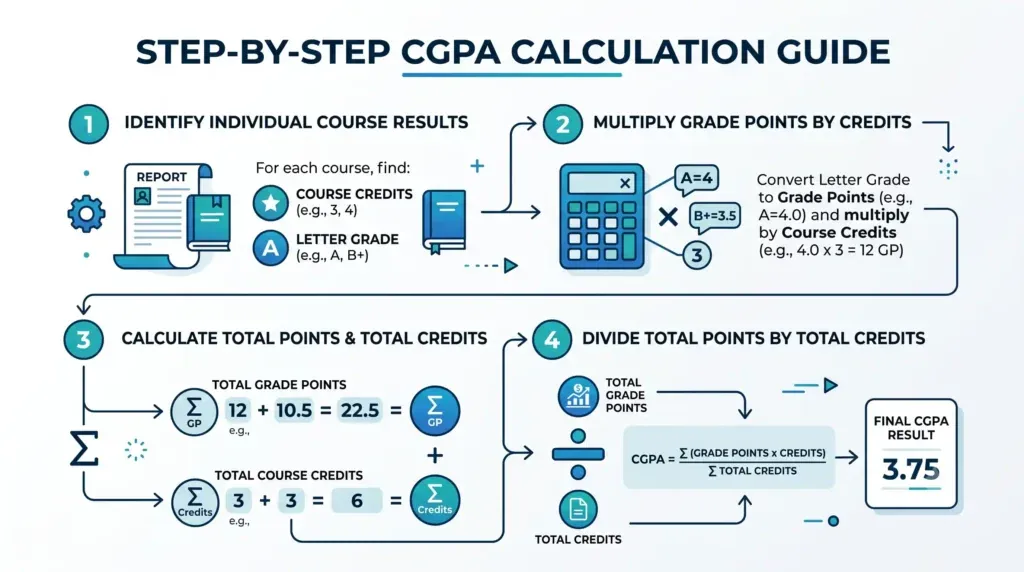
Follow these steps to calculate your CGPA:
Step 1: List every course with its credit hours and marks
Write down each course, its credit hours, and the grade point earned (on the 4.0 scale — for example A = 4.0, B = 3.0, C = 2.0).
Step 2: Get the grade point for each course from your marks
Your percentage (obtained ÷ total × 100) determines the grade. Multiply the grade point by credit hours to get “quality points” for each course.
Step 3: Add up the quality points and the credit hours
Sum all quality points, then sum all credit hours.
Step 4: Divide total quality points by total credit hours
The result is your CGPA out of 4.0.
| Course | Credit Hrs | Total | Obtained | Grade (GPA) | Quality Points |
|---|---|---|---|---|---|
| Calculus | 3 | 100 | 88 | A (4.00) | 12.00 |
| Programming | 4 | 100 | 76 | B+ (3.33) | 13.32 |
| English | 3 | 100 | 72 | B (3.00) | 9.00 |
| Physics | 3 | 100 | 82 | A− (3.67) | 11.01 |
| Total | 13 | — | 45.33 |
CGPA = 45.33 ÷ 13 = 3.49 out of 4.0. Enter these marks in the calculator above — it auto-assigns the grades and verifies the CGPA.
How to Convert CGPA into Percentage
Once you know your CGPA, converting it to a percentage helps when applications ask for marks in percent. The method depends on your grading scale.
Converting CGPA to percentage on the 4.0 scale
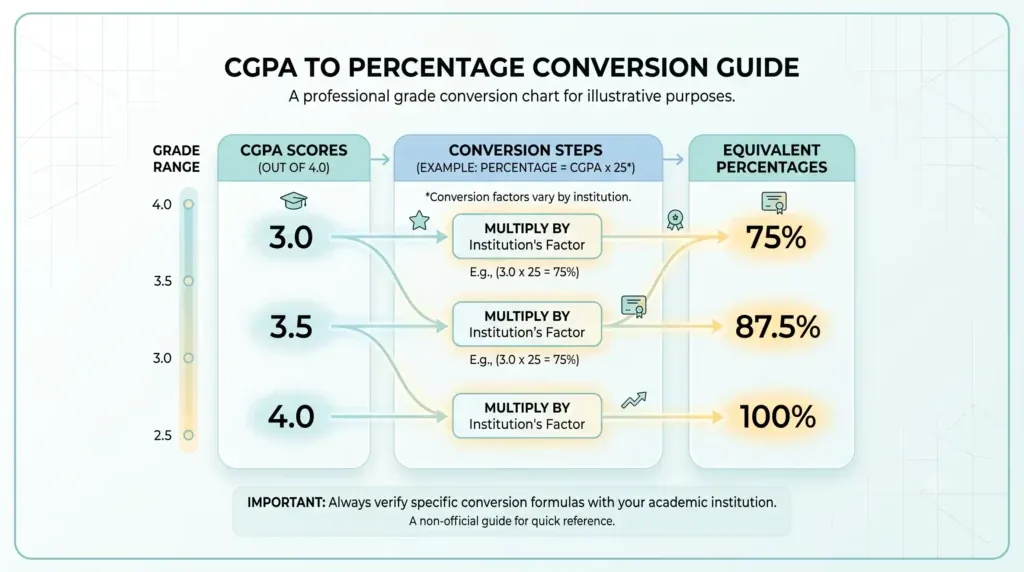
For a 4.0 scale, the standard formula is Percentage = (CGPA ÷ 4.0) × 100, which is the same as CGPA × 25. So a 3.49 CGPA equals about 87.25%. This is the default method used by our converter and by most HEC-recognised universities in Pakistan.
Converting CGPA to percentage on the 10-point scale
Universities that grade on a 10-point scale (common in India and some international systems) typically use Percentage = CGPA × 9.5. Use the “10.0 scale” option in the calculator if your CGPA is out of 10 rather than 4.
If you also need marks-based conversions, our percentage calculator for marks, division and grade handles raw obtained/total marks directly.
How to Calculate CGPA in Pakistan (HEC & University Standards)
In Pakistan, the Higher Education Commission (HEC) recommends a 4.0 GPA scale, and most universities follow it — so learning how to calculate CGPA in Pakistan uses the same total-grade-points ÷ total-credit-hours formula shown above. What differs slightly between universities is the grade-to-point mapping and the
marks range for each grade.
| Grade | GPA | HEC Standard (NUST, COMSATS) | Conservative (NUML, Punjab) |
|---|---|---|---|
| A | 4.00 | 85–100% | 90–100% |
| A− | 3.67 | 80–84% | 85–89% |
| B+ | 3.33 | 75–79% | 80–84% |
| B | 3.00 | 70–74% | 75–79% |
| B− | 2.67 | 65–69% | 70–74% |
| C+ | 2.33 | 60–64% | 65–69% |
| C | 2.00 | 55–59% | 60–64% |
| C− | 1.67 | 50–54% | 55–59% |
| D+ | 1.33 | 45–49% | 53–54% |
| D | 1.00 | 40–44% | 50–52% |
| F | 0.00 | Below 40% | Below 50% |
COMSATS: a COMSATS CGPA calculator uses the same 4.0 formula; COMSATS applies a relative/absolute grading policy where letter grades map to the points above. NUST and Punjab University likewise follow the HEC 4.0 GPA rules, though exact marks bands for each grade differ by department. Why two scales? Universities like NUST, COMSATS and FAST follow the HEC standard scale where an A grade starts at 85%. Traditional universities like NUML, Punjab University and Quaid-i-Azam University use a conservative scale where an A starts at 90% — meaning the same marks can produce a different CGPA depending on your university. Our calculator above lets you select your university so the correct grading scale is applied automatically.
Always cross-check your transcript’s official key. If you are calculating admission merit rather than CGPA, see our NUST aggregate calculator for entry-test-based merit.
CGPA to Percentage Conversion Table
The formula depends on your grading scale. On a 4.0 scale, percentage = CGPA × 25; on a 10-point scale, percentage = CGPA × 9.5. Use these reference values, or the calculator above for an exact figure.
| CGPA (4.0 scale) | Percentage | CGPA (10-point) | Percentage |
|---|---|---|---|
| 4.0 | 100% | 10.0 | 95% |
| 3.5 | 87.5% | 9.0 | 85.5% |
| 3.0 | 75% | 8.0 | 76% |
| 2.5 | 62.5% | 7.0 | 66.5% |
| 2.0 | 50% | 6.0 | 57% |
Some universities publish their own conversion formula, so check your institution’s handbook if an application needs an official figure.
How to Find CGPA from GPA and SGPA
Your SGPA (or semester GPA) is the grade point average for a single semester; your CGPA is the average of every semester so far, weighted by each semester’s credit hours:
CGPA = Σ(SGPA × semester credits) ÷ Σ(total credits)
If every semester carries the same number of credits, this is simply the average of your semester GPAs. For example, SGPAs of 3.6, 3.4, 3.8 and 3.2 over four equal semesters give a CGPA of (3.6 + 3.4 + 3.8 + 3.2) ÷ 4 = 3.5. To convert an SGPA to a percentage, use the same × 25 (4.0 scale) or × 9.5 (10-point) formula as above.
CGPA to GPA Conversion (10-Point to 4.0 Scale)
Students applying abroad often need a 10-point CGPA expressed on the US 4.0 scale. A common quick approximation is GPA (4.0) = CGPA (10) × 0.4:
| CGPA (10-point) | Approx. GPA (4.0) |
|---|---|
| 9.0 | 3.6 |
| 8.5 | 3.4 |
| 8.0 | 3.2 |
| 7.5 | 3.0 |
| 7.0 | 2.8 |
This is only a guide. Official evaluators such as WES map your marks grade-by-grade rather than with a single multiplier, so the exact GPA on your credential evaluation may differ.
How to Convert CGPA to Marks
To estimate the marks behind a CGPA, first convert it to a percentage, then apply that to the total marks. For a CGPA of 3.0 on the 4.0 scale (3.0 × 25 = 75%), the equivalent out of 1,000 total marks is 750. The reverse also works: divide your obtained marks by the total, multiply by the scale (4 or 10), to get the grade point.
What CGPA Do You Need for Masters, MBA and Scholarships?
Requirements vary by programme and country, but as a general guide on the 4.0 scale:
- Masters / MS: most universities set a minimum of 2.5–3.0; competitive programmes prefer 3.3 and above.
- MBA: typically 3.0+, though strong work experience can offset a lower CGPA.
- Scholarships (HEC, Fulbright and similar): usually 3.0/4.0 (about 60%) or higher, with the most competitive awards expecting 3.5+.
Always confirm the exact cut-off on the official programme page, as some accept a percentage or a lower CGPA with other strengths.